
What happens in aorta stenosis? The blood is forced into the aorta via a stenosed valve. This causes the cardiac outflow to become turbulent.
Remarkably, turbulence becomes preceded by a phase of laminar flow that grows in importance towards periphery.
The co-existence of a laminar phase preceding the turbulence of the cardiac ejection phase shows once more that the arterial system is able to add energy to the pressure wave from the heart.
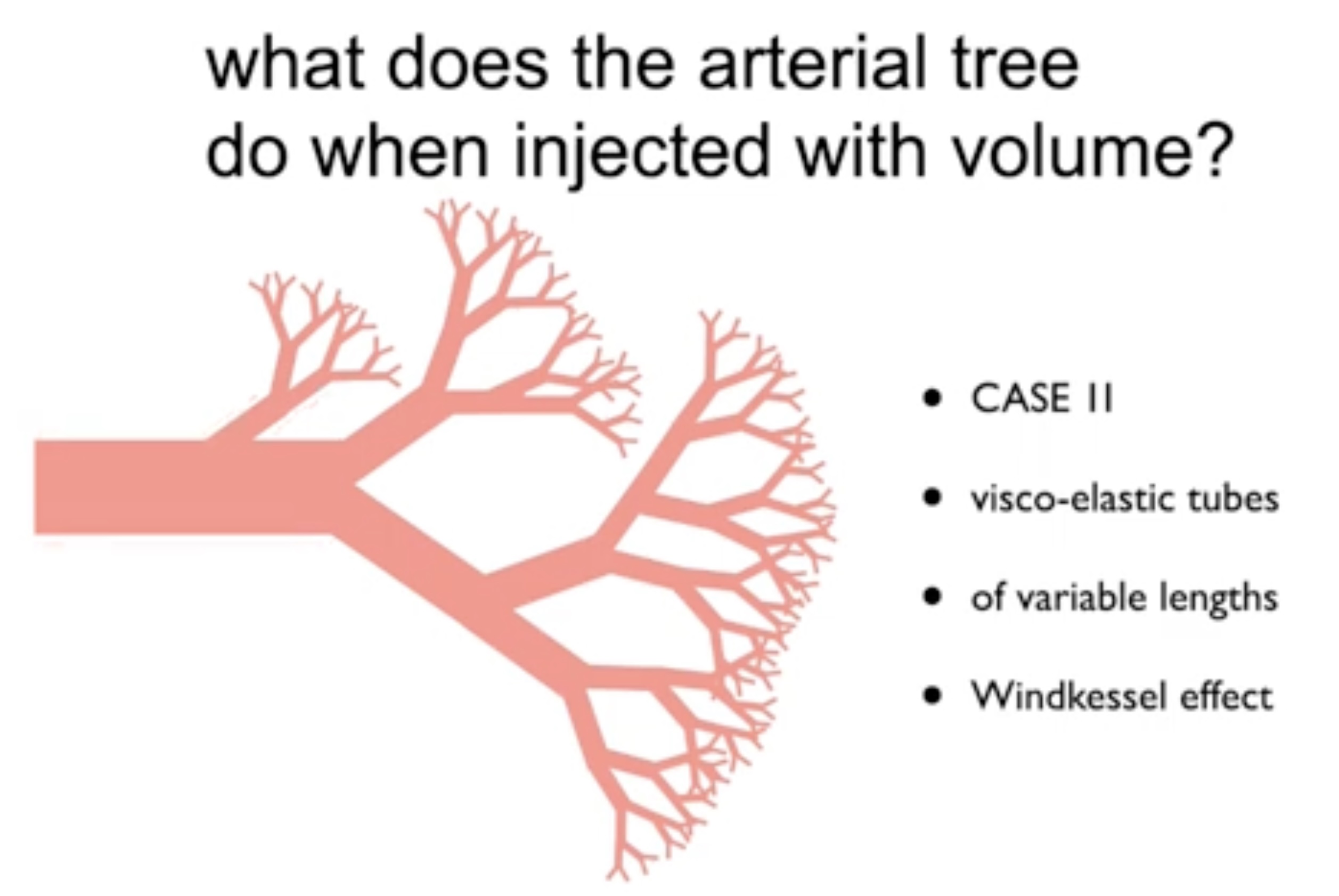
In this video the physiology of the arterial tree is explained by discussing the various theories that have been formulated starting from Harvey in 1628 to the theory of arterial acceleration published in 2014.
In a joint effort DWL and Neuromon B.V. have recently made the new TCD parameters available for current and future DWL customers. In the latest QL software signal analysis based upon the new TCD parameters is optionally available. It can be acquired via the DWL distributors network. The new TCD parameters significantly enhance signal analysis and interpretation. Please refer to relevant literature.


Neuromon Privacy Policy
This privacy policy was last modified on the 4th of November 2018.
Neuromon BV. operaties www.neuromon.eu ("the Site"). This page informs you of our policies regarding the collection, use and disclosure of Personal Information we receive from users of the Site.
We use your Personal Information only for providing and improving this Site. By using the Site, you agree to the collection and use of information in accordance with this policy.
Information Collection and Use
While using our Site, we may ask you to provide us with certain personally identifiable information that can be used to contact or to identify you. Personally identifiable information may include, but is not limited to your name and email address ("Personal Information").
Log Data
Like many site operators, we collect information that your browser sends whenever you visit our Site ("Log Data"). This Log Data may include information such as your computer's Internet Protocol ("IP") address, browser type, browser version, the pages of our Site that you visit, the time and date of your visit, the time spent on those pages and other statistics.
Vasovagal collapse is a common reason for unconsciousness. Many of us will experience a vasovagal collapse or syncope once or more during their lifetime. Though mostly innocent, to many of us the experience of a sudden and unwanted loss of consciousness is most disturbing, especially when bystanders witness the attack and call for help of emergency services. People with vasovagal collapse have been resuscitated (sometimes causing multiple rib fractures) and have been brought to hospital by the emergency services. People brought into hospital have often been subjected to all kinds of ancillary investigations such as ECG, EEG, 24-hours ECG or have even received implants for monitoring their heart rhythm over prolonged periods with regular checkups at the cardiologist.
Vasovagal collapse may be accompanied by a complete stop of cardiac activity or asystole. This is caused by excessive inhibition of the heart by overactivity of the vagal nerve. This blockade is always self-limiting and it will stop spontaneously, usually within a minute, allowing the heart to start beating again. Even doctors are not always familiar with the occurrence of asystole in the course of a vasovagal collapse. They tend to order extra investigations to minimise the risk of heart disease. You will understand that undergoing all these extra and unnecessary investigations does not help to comfort someone who has experienced this rather innocent loss of consciousness.
How does a vasovagal collapse occur?
What happens during a vasovagal collapse? For this we turn to a detailed registration of ECG (blue), blood pressure (red) and blood flow velocity to the brain (green) recorded in a patient experiencing vasovagal collapse during a so-called tilt-table test (see below). A tilt-table test is a clinical examination during which a patient is strapped to a table which from a horizontal can be brought to a vertical position. This is a controlled situation allowing all kinds of physiological parameters to be recorded safely.
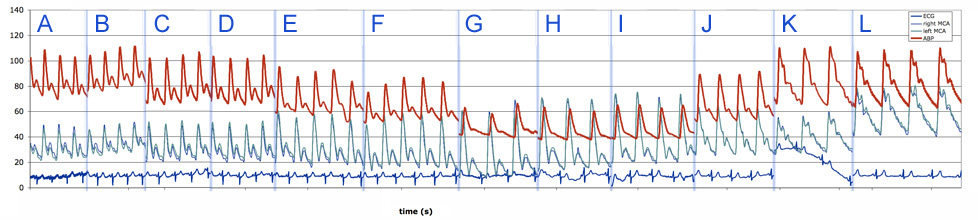
The onset of a vasovagal collapse can be triggered by standing, by emotional stress or by pain. Presumably, these cause a sudden loss of venous tone in the large capacitance vessels of the body. The blood pools in the lower parts of the body and less and less blood reaches the heart causing cardiac output to decrease (C-D). It is likely that some degree of hyperventilation also plays a role. Hyperventilation causes further relaxation of the capacitance vessels and in addition also causes narrowing of the feeding arteries to the brain. Now cerebral perfusion is even more reduced. The body tries to overcome these difficulties by exaggerating the arterial acceleration (E-I), this is a brief constriction of the arteries during the first phases of each heart beat. This mechanism can temporarily keep some blood flowing to the brain but because of the high pressures it is accompanied by bradycardia: a reflex is activated inhibiting the frequency with which the heart beats (the baroceptor reflex). When strong enough this reflex may even cause the heart to stop beating completely, called asystole. Obviously, blood supply to the brain completely stops and the cerebral mechanisms maintaining consciousness and body posture fail: the person loses consciousness and -in an uncontrolled condition- falls to the ground. Brain activity, recorded by EEG, will stop completely (becomes iso-electric).
The complete loss of brain function explains why the excessive vagal activity is self-limiting: with no blood flowing to the brain the vagal nerve cannot maintain it's activity. The heart is released from excessive vagal inhibition and starts beating again. Cardiac output increases rapidly and the blood flow to the brain is restored (J-L). The person regains consciousness, usually a bit confused but most often no longer than for a period of 1-2 minutes. After a vasovagal collapse subjects may feel weak and nauseous for some time. Usually they maintain a lower heart rate than before the collapse and putting them on their feet too early may evoke a second attack.
Preventing a vasovagal collapse
So what can be done to prevent this unwanted sequence of events? Important is to eat regularly. Many persons experience a collapse after skipping breakfast. Sleep regularly. Avoid situations with long standing and try to find a seat. Many people recognise the feeling of a beginning collapse. Then again, when standing find a place to sit or lie down. Of course, this can be inconvenient or even quite embarrassing but compare this with really losing consciousness and falling to the floor sometimes with loss of urinary or bowel control! In true emergency situations you can try to cross your legs and push them together to prevent blood from pooling in the lower extremities. Then concentrate on your breathing and try to breathe as little as possible. By preventing hyperventilation, which is the normal response to feeling uncomfortable, the blood vessels in the brain will remain open. In this way time is gained allowing the feeling of near fainting to subside.
Witnessing a vasovagal collapse
When witnessing a vasovagal collapse, try to put the person in a supine position with the legs up (causing venous blood to flow to the heart). Wait a while (maximum of 60s) for the heart rhythm to recur spontaneously before starting cardiac resuscitation. When no heart beats can be felt in the person's neck for a period exceeding 60 seconds vasovagal collapse is uncertain and bystanders should be asked to call the emergency services while resuscitation is started.
